

The Methane Problem in Modern Tennis: Why Sustainability Starts in the Ball Tube
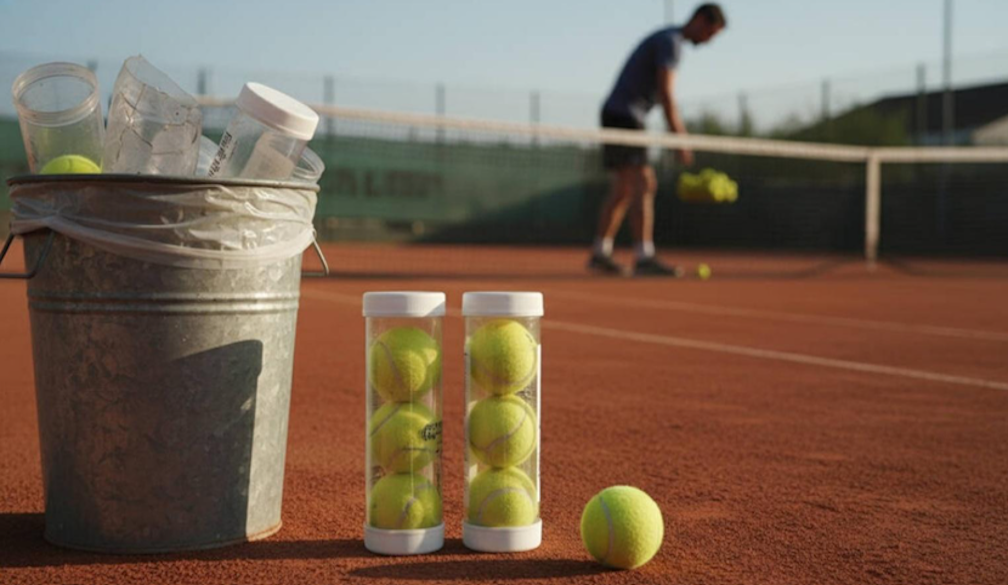
In the global conversation about sporting sustainability, most attention lands on stadium infrastructure, single-use plastics at major tournaments, and athlete travel. A far more persistent environmental threat is hiding in plain sight: the tennis ball. While a single ball appears harmless, the scale of production is staggering.
Approximately 325 million tennis balls are manufactured every year. Because these items are engineered as pressurised, non-biodegradable consumables, they represent one of the most significant linear waste problems in modern sport.
For the Australian tennis community, from the local clubs in Sydney to the grassroots courts in Melbourne and Brisbane, this is a challenge that often goes unnoticed. We pride ourselves on our reputation for outdoor living and environmental awareness, yet our kit bags are filled with equipment that carries a devastating long-term environmental cost.
The 400-Year Decay Cycle and the Landfill Crisis
A tennis ball is a complex composite of rubber, adhesives, and synthetic felt. Because of the industrial-grade vulcanisation required to make them bounce, they are notoriously difficult to recycle through traditional municipal streams. When discarded after just a few hours of high-level play, they begin a 400-year journey of decomposition in landfill.
In Australia, where waste management is under increasing regulatory pressure and landfill levies continue to rise, the volume of rubber waste generated by the tennis industry is a serious concern.
As this rubber slowly breaks down in an anaerobic environment, it produces methane, a greenhouse gas with a warming potential significantly higher than carbon dioxide over a twenty-year period. When we throw away a "dead" ball, we are not just tossing a piece of rubber. We are contributing to a chemical process that actively undermines the climate goals our nation is striving to achieve.
The vulcanisation process creates a molecular structure that nature simply does not know how to dismantle. The cross-linking of polymer chains with sulphur makes the rubber incredibly durable, a benefit on the court but a nightmare in the ground. While a banana peel might take weeks to decompose and a plastic bottle might take centuries, the vulcanised core of a tennis ball sits in the earth, largely unchanged, for generations.
Microplastics and the Fuzz Factor
Beyond the landfill, the tennis ball contributes to a more invisible form of pollution. The signature fuzz on a ball is typically a blend of wool and synthetic fibres like nylon or polyester. During every high-velocity strike, microscopic plastic fibres are abraded from the ball's surface and released into the air and local waterways. This microplastic shedding is an inherent byproduct of traditional equipment design, meaning that even before a ball is thrown away, it has already begun to leave an ecological footprint.
Every time a ball skids across a hard court or hits the damp grass of an Australian park, it sheds these synthetic markers. Research into microplastics has shown that these tiny particles find their way into our soil and our oceans, eventually entering the food chain.
For a country so deeply connected to its coastlines and marine life, the thought of tennis equipment contributing to that cycle is a sobering reality. It suggests our recreational choices have ripples that extend far beyond the baseline, and that understanding the physics of what causes a ball to "die" in the first place is essential.
The Physics of the Dead Ball
The primary reason for the high turnover of tennis balls is pressure loss. Because natural rubber is porous at a molecular level, the internal 14 psi of a ball begins to equalise with the atmosphere the moment the vacuum-sealed can is opened. Once a ball loses its spring, it is deemed useless for competitive play, even if the structural integrity of the rubber and felt is perfectly intact.
Every player has experienced this. You open a fresh tin on a Saturday morning, and by Sunday afternoon the balls feel heavy. They do not fly through the air with the same crispness, and they sit on the strings for a fraction of a second longer. This is not just inconvenience. It is a fundamental shift in the physics of the game. When internal pressure drops, the ball no longer deforms and recovers with the same efficiency, which means less energy returned to the player on impact.
That energy deficit has real physical consequences. To get the ball over the net and deep into the court, players compensate by swinging harder and muscling through their strokes. This overcompensation is a leading cause of lateral epicondylitis, commonly known as tennis elbow, and it places undue stress on the rotator cuff and wrist. In Australia, where we have a vibrant masters tennis community and many ageing players who want to stay active, equipment quality is genuinely a health and safety issue.
The Circular Solution: Pressurisation versus Replacement
This is where the science of the game meets the reality of the kit bag. PressureBall offers a way to stop, and reverse the clock on that decline, providing a pressurised environment that keeps the air inside the ball where it belongs. Instead of allowing the ball to fight a losing battle against outside air pressure, it is placed in a sealed tube where pressures are balanced, preventing internal air from escaping through the porous rubber.
It is a simple, elegant correction to the physics of pressure loss, ensuring that when you head to the court, you are bringing the bounce back with you.
Economic Benefits for the Local Player
While the environmental argument is compelling, the economic reality for Australian players is equally important. Tennis is an expensive sport. Between club memberships, tournament fees, and coaching, the costs add up quickly. The constant need to buy new balls, often at ten to fifteen dollars per tin, is a significant ongoing expense.
For a coach running a large academy or a parent supporting a high-performance junior player, the annual ball budget can run into the thousands. A pressure-maintenance tube costs a fraction of that, and when a ball lasts three or four times longer than it otherwise would, the return on investment is immediate. For anyone ready to make the switch, the PressureBall shop has everything you need to get started. It is one of the most straightforward ways to make the sport more accessible for families across the country.
Toward a Post-Linear Sport
As we move further into this decade, the "play and toss" mentality is becoming an outdated relic. The path to a truly sustainable sport requires a two-pronged approach: better recycling technology for balls that have genuinely reached the end of their life, and wide-scale adoption of pressure-maintenance tools to keep balls in play for as long as possible.
Prevention is always more efficient than cure. While recycling is a worthwhile goal, it still requires energy for transport and processing. Extending the life of a ball at the source is the most direct way to reduce the sport's environmental footprint. It is also the simplest form of consumer responsibility, the kind of intelligent ownership that aligns with the broader global shift toward longevity in the goods we buy.
A Call to Action for Aussie Players
The Australian tennis scene has a genuine opportunity to lead in sustainable sporting practice. By changing how we store our equipment, we can create a meaningful cumulative impact. If every club in the country used pressure-maintenance technology for their coaching hoppers, the reduction in landfill waste would be measured in tonnes.
It is time to stop treating tennis balls as disposable items and start treating them as the high-performance, pressurised tools they are. The bounce is in your court. Make it last.
