

Narrow Street, No Rear Access? What Illawarra Homeowners Need to Know Before Building a Pool
For a lot of homeowners in the Illawarra's older suburbs, the first hurdle to building a backyard pool isn't choosing a shape or a finish — it's working out whether the pool can physically get into the yard at all. Streets in areas like Bulli, Thirroul, Fairy Meadow and parts of Wollongong's inner suburbs were laid out long before backyard pools were common, which means narrow frontages, tight side access, and no rear laneway are the norm rather than the exception.
That's a fair concern, and one worth raising early with any pool builders homeowners are considering, rather than after a design has already been chosen. Fibreglass pools in particular arrive on site as a single pre-formed shell, so the entire structure needs a clear path from the street to the backyard — usually lifted over the roofline by crane. Concrete pools don't carry the same constraint, since they're built in place, but they come with their own trade-offs around build time and ongoing maintenance.
Why Access Comes Before Design
Most pool research starts with the fun part — shapes, colours, depth, features. But on a block with restricted access, the practical question of how the shell gets in has to be answered first, because it can genuinely rule some options in or out. A site assessment that only measures the backyard, without accounting for the path in from the street, isn't a complete assessment.
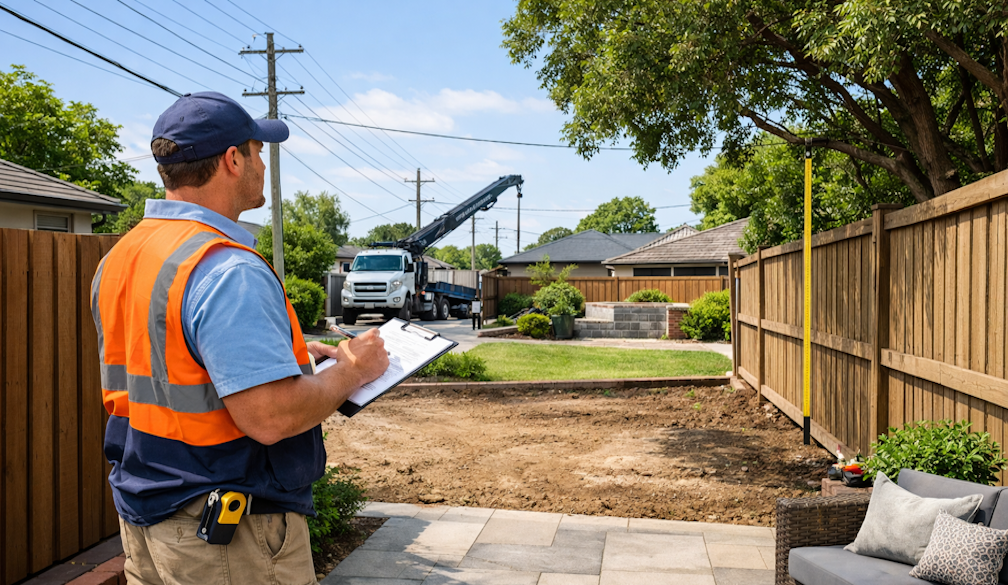
This is why an early site visit matters more than it might seem. A proper assessment looks at street width, the position of powerlines, fence heights, overhanging trees, and the turning space needed for a crane truck to safely manoeuvre. All of this needs to be understood before a shell size or shape is locked in, not discovered partway through the project.
It also affects scheduling in ways that aren't always obvious upfront. A site with straightforward access can often move from consultation to delivery in a fairly predictable timeframe, because the logistics are simple and well understood. A site with genuine access constraints may need extra lead time to book the right crane, confirm a permit, or coordinate with neighbours if a shared driveway or right-of-way is involved. None of that is a reason to avoid the project — it's simply part of planning it properly, and it's far easier to build into a timeline from day one than to absorb as a delay later.
How Crane Access Gets Assessed
Most fibreglass pool deliveries rely on a crane lifting the shell over the house and into the backyard. Whether that's possible — and what kind of crane is needed — comes down to a handful of measurable factors: the width of the street for the truck itself, clearance from powerlines along the route, the swing radius required to lift the shell safely, and how much room there is to stabilise the crane once it's in position.
On wider, more modern streets, a standard crane truck is usually sufficient. In older, narrower Illawarra streets, a shorter-boom crane or a more manoeuvrable mobile crane may be required instead. Neither option should come as a surprise on installation day — a competent site assessment identifies which is needed well before the build begins, and factors any additional cost or scheduling into the plan from the outset.
When Standard Access Isn't an Option
A smaller number of properties have genuinely limited access — think narrow rear laneways, low-hanging power infrastructure, or established trees that can't reasonably be trimmed. These sites aren't necessarily out of the running for a pool, but they do call for a different approach.
In some cases, a smaller shell can be manoeuvred into place manually with the right equipment. In rarer cases, specialised lifting solutions are used for sites with no workable ground access at all. These alternatives generally add time and complexity to a project, which is exactly why they need to be identified and priced in during the planning stage — not treated as a last-minute workaround.
Council Permits and Street Closures
If a crane needs to stand on the road itself to complete the lift, that usually isn't something a homeowner can simply organise on the day. Most councils across the Illawarra require a permit if a vehicle will occupy part of a traffic lane or footpath for an extended period, and the process for securing that permit varies between local government areas.
This sits alongside the other standard council requirements for a pool build — development consent and pool safety compliance among them — and is generally something an experienced builder manages as part of the overall project, rather than something left for the homeowner to sort out separately.
The permit itself typically covers the specific day and hours of the lift, along with any traffic management measures required, such as signage or a temporary lane closure. Requirements and turnaround times differ between local government areas, which is one of the reasons local experience matters here — a builder who has already worked through the process with a particular council knows what to submit, how long approval usually takes, and how to schedule the delivery date around it with some confidence.
Matching the Pool to the Block
A restricted access point doesn't have to mean settling for a much smaller pool than originally planned, but it can influence which shell shapes and sizes are realistic. Ranges designed with narrower backyards in mind tend to work well here, offering a usable, well-proportioned layout without requiring the widest possible access path. For particularly tight sites, a compact plunge-style pool is often the most practical starting point, since it can deliver a genuinely useful swimming space within a much smaller footprint.
The key is working through these options at the design stage, with the access constraints already on the table — rather than falling for a shape or size that later turns out to be impossible to deliver.
The Bottom Line
Narrow streets and restricted access are common realities across much of the Illawarra's established suburbs, but they're rarely a reason to abandon the idea of a pool altogether. What makes the difference is an honest, thorough site assessment early in the process — one that accounts for the path in, not just the space at the other end of it. Homeowners who raise access as a question from the very first conversation, rather than an afterthought once a design is chosen, tend to have a far smoother path from consultation to a finished pool.
