
How a Motorbike Hoist Raises, Locks, and Steadies a Bike for Safe Maintenance
Spring and summer bring riders back to the garage to service chains, change tyres, and tune engines before the long rides, and doing that job on the ground is hard on the back. A scissor lift designed for motorcycles raises the machine to a comfortable working height and holds it steady, and the same design suits quad bikes and other small vehicles. Understanding how a motorbike hoist works helps owners use one safely and get the most from it.
Why Lifting a Bike Helps
Working crouched beside a bike strains the back and knees, and a bike propped on a stand can topple. A hoist lifts the whole machine on a flat platform, putting the engine, chain, and wheels at waist height. That makes a long job easier and reduces the chance of mistakes. A bike on a hoist is also easier to clean and inspect.
How a Scissor Mechanism Works
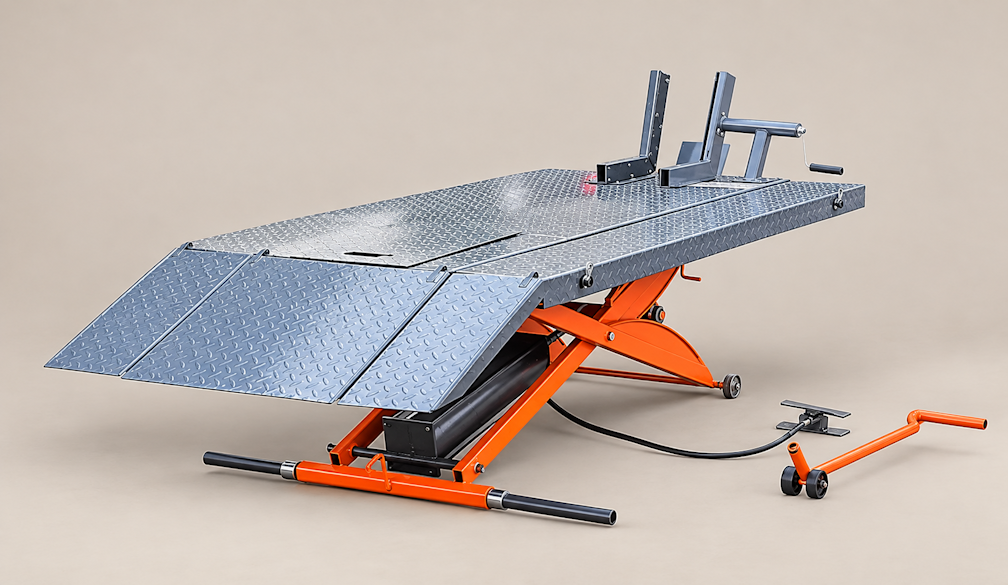
A scissor lift uses two sets of crossed steel arms, hinged in the middle, that fold flat when lowered and stand up as they extend. A hydraulic cylinder pushes the arms to raise the platform. Because the arms form triangles, the structure is strong and stable for its size. A foot pedal or a hand pump pressurises the oil, and a release valve lowers the lift slowly.
Locking the Lift
A hydraulic lift should never be trusted alone. A mechanical lock, usually a bar or ratchet that engages as the platform rises, holds the platform in place even if the hydraulics fail. Always lower the lift onto its lock before working on the bike. Never place any part of your body beneath a raised platform that is not locked.
Choosing Platform Size and Capacity
Check the rated capacity against the heaviest machine you plan to lift, including any luggage or accessories, and leave a safety margin. The platform should be long enough to hold the whole wheelbase, with room to strap the machine at both ends. A lift with side extensions suits wide cruisers and quad bikes, while a narrow platform is easier to store. A motorbike hoist that is too small is more dangerous than no hoist at all.
Securing the Bike
A bike must be strapped down before it leaves the ground. A wheel clamp or chock holds the front wheel, and ratchet straps hold the frame to the platform. Place the straps so they pull in different directions, keep them away from brake lines and cables, and check them again once the bike is raised. A bike that shifts on a platform can fall suddenly.
Wheel Chocks, Straps, and Tie Points
The wheel clamp holds the front wheel upright, but the straps do the real work of keeping the bike in place. Use quality ratchet straps with soft loops, attach them to solid frame points rather than to plastic parts or handlebars, and avoid crossing brake and clutch cables. Pull the straps evenly until the suspension compresses slightly, then check them again after the first lift.
Balance and Centre of Gravity
A motorbike is tall and narrow with its weight high up, so it is easy to tip. Position it so the centre of gravity sits over the middle of the platform, with the front wheel at the clamp end. Side extensions give extra support for wider bikes and quad bikes. Raise the lift only as high as needed, since a lower platform is more stable.
Using It for Quad Bikes
An all-terrain vehicle, known as an ATV, is wider and heavier than a motorbike, so check the rated capacity and the platform width. Many hoists have side extensions that widen the platform for a quad. Chock the wheels, strap both axles, and raise slowly. A heavy machine on a narrow platform is a hazard.
Setting Up a Home Workshop
A garage that holds a motorbike hoist needs light, power, and storage as well. Mount a bright light overhead, keep tools within reach on a bench or trolley, and put a fire extinguisher by the door. A motorcycle hoist is easiest to use when there is clear space around three sides of the platform, so keep stored items against the walls. A rubber mat under the lift reduces slipping and protects the floor.
The Floor and the Workspace
Place the lift on a level concrete floor, because a slope or a cracked slab can tilt the platform. Leave space around the lift for tools and for walking. Keep the floor clean of oil, since a slippery surface makes lowering and strapping risky. Good lighting helps too.
Jobs a Raised Bike Makes Easier
At working height, a rider can change tyres, replace chains and sprockets, adjust the brakes, check the suspension, and service the engine. Many jobs need the wheels to turn, and a lift that holds the bike securely with the wheels free makes that easy. Some jobs, such as removing the rear wheel, change the balance, so re-check the straps after each major step. Tasks like oil changes are easier when the bike is level, so use the platform controls to adjust.
Mistakes to Avoid
The common errors are simple. Raising the bike before strapping it, working beneath the platform without the lock, using a hoist on a sloping or cracked floor, and ignoring the rated capacity all lead to accidents. A motorcycle lift is not a substitute for good habits, and checking each step takes less time than recovering from a fall.
Rules for Working on a Raised Bike
A few rules apply every time:
- Strap the bike before raising it
- Lower onto the lock before working
- Keep fingers clear of the scissor arms
- Never exceed the rated load
Maintenance of the Hoist Itself
A lift is a machine that needs its own care. Check the hydraulic oil level and look for seepage around the cylinder and hoses. Grease the pivot points and the lock mechanism, and wipe the arms clean so dirt does not wear the bushes. Test the lock every few months without a load to make sure it engages firmly. If a part shows damage or cracks, stop using the lift until it is repaired.
Cleaning and Storing the Lift
Check hydraulic oil, look for leaks, and grease the pivot points. A portable lift usually has wheels or a handle so it can be moved aside. Clean it after use and store it with the platform lowered. A motorbike hoist that is looked after will keep a garage safe through many seasons, and owners who set up a home workshop often look at the wider range of equipment for garages and sheds so that lifting, storage, and benches suit the space.